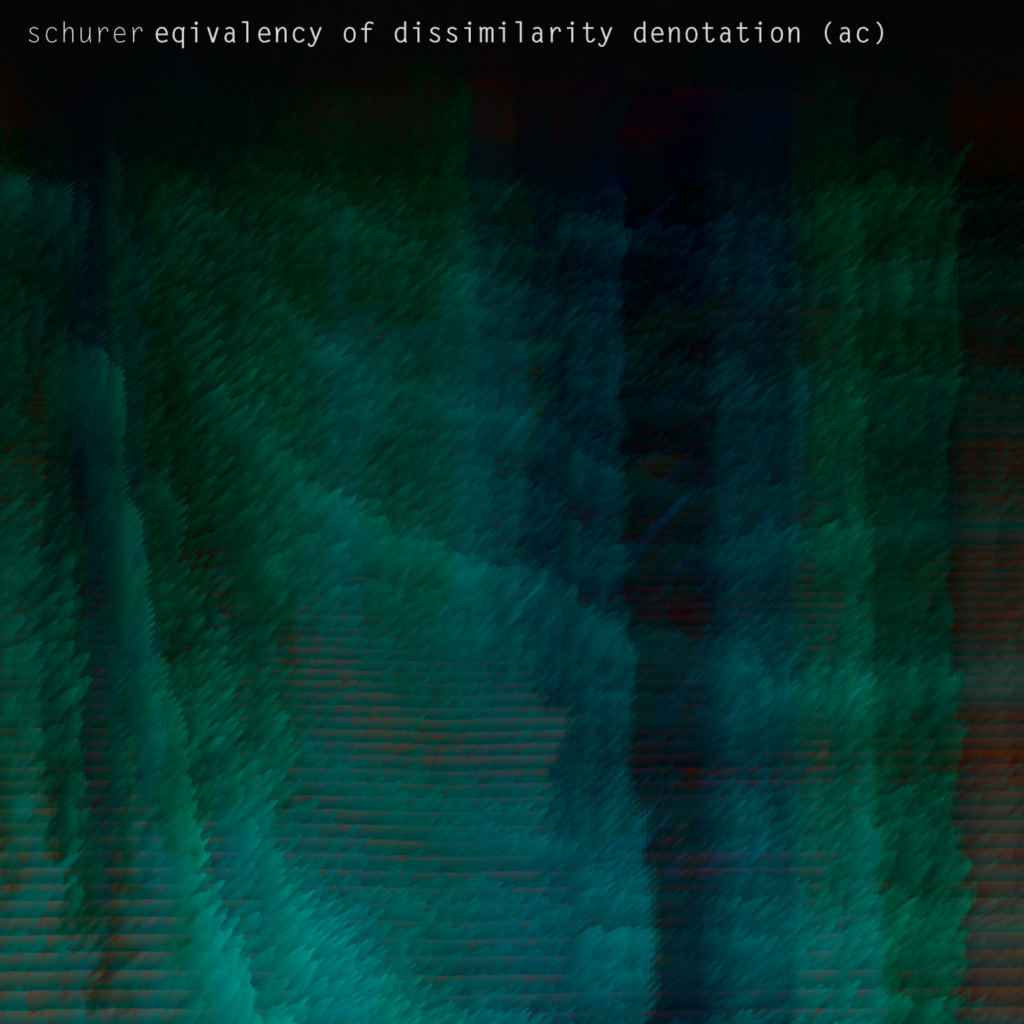
equivalency of dissimilarity denotation (analog shift registers) 2026
EoDD/XVM, a collective of conceptual art works initiated by Bernd Schurer, emerged as a revolutionary force in the nascent days of the internet art world in the late 1990s. Their creations transcended traditional mediums, utilizing hypertext, the internet, and analog and digital sound computers. Unlike conventional art, XVM prioritized ideas, perception, and critical reflection over physical objects, spectacle, and performance. By challenging established art concepts and rejecting non-systematic approaches to philosophical debate, system theory, and cybernetics, they fundamentally redefined notions of authorship, (re-)presentation, and art-making. The group’s work centered around probing the systems that imbue art with meaning. Through their antiorp.net channel, XVM engaged in “Art as Philosophy,” presenting powerful sound pieces, obfuscated HTML code, and introspective musings and ramifications as schizo-personas.
Bernd Schurer (born, Zurich, 1970) is a sound artist, researcher, and composer of electronic music living in Berlin for the last 18 years.
Schurer is one the absolute pioneers of extreme computer music amongst other mischievous and radical online activities in the nascent days of the internet.
In a long running and somewhat confrontational practice Schurer has explored physical and psychological experiences through computational formalization processes.
Soliloquy Synthesis was created in anticipation of his father’s passing.
The composition was presented in front of an intimate audience at the NNOI festival in Zernikow, Brandenburg, Germany, July 2025. A week after the anticipated event transpired.
Under twinkling stars and flickering fires, what was it good for? A game.
Gratitude to all you beautiful beings: Maria, Josef, Sonja, Alberto, Marcus, Renate, Eliane, Jason B, Simon B., Simon G., Miriam, Bettina, Michael, Robert, Randy, Chris J, Sabine, Mark, Stephan W and Marina.
credits
released March 26, 2026
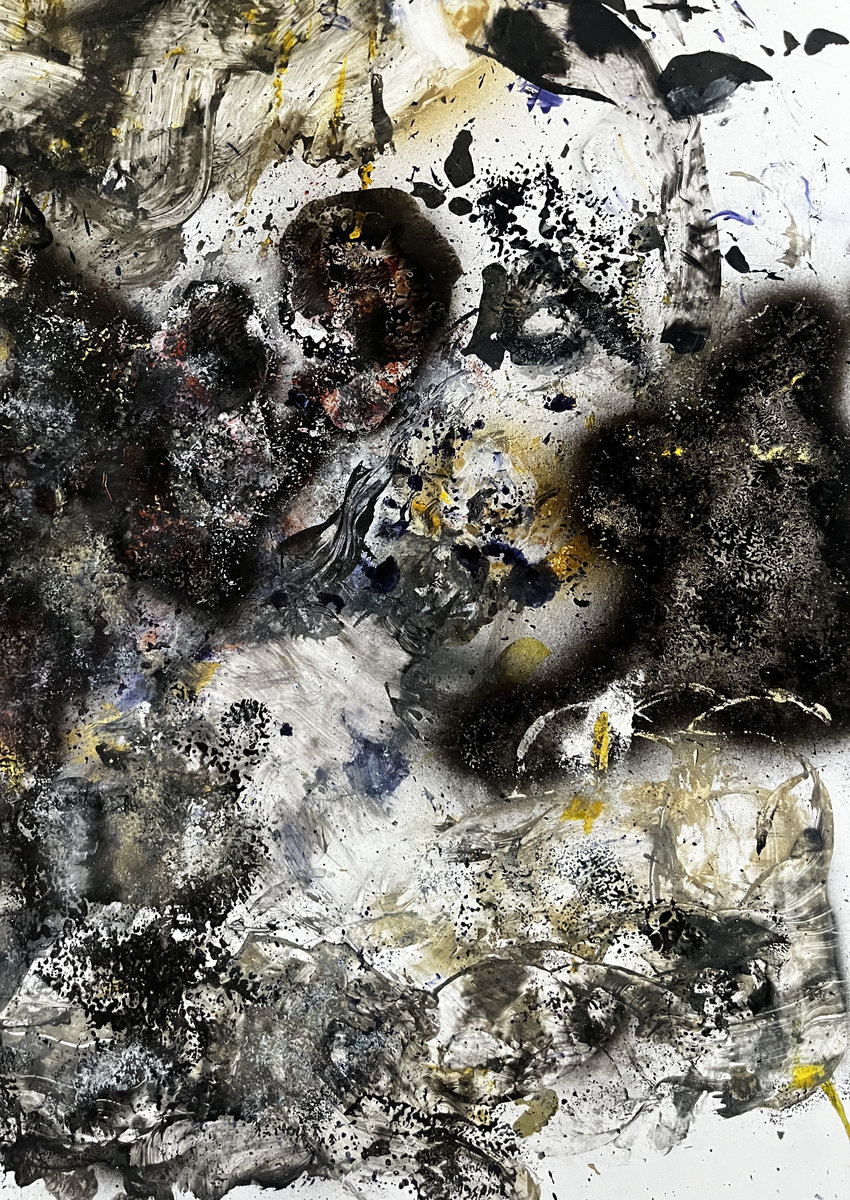
Music by Bernd Schurer. Mastered by Rashad Becker. Cover Painting by Mark Harwood.
Some experimental philosophical thoughts on “The Narrow.” started out as a conversation with ChatGPT about the Tritone Paradox in my computer music composition, Lacanian Sieve.
_
1. Narrowness as a Constraint on the Symbolic
When a piece commits to one interval as its total structural horizon, the listener is placed in a space where symbolic differentiation is strictly limited. The Symbolic (in Lacanian terms) becomes a single axis—a filtration of all musical possibility through one cut, one relation, one “law.”
Psychologically, this produces:
A sense of cognitive claustrophobia: the mind searches for alternative relations, but the system refuses them.
A heightened awareness of micro-differences: the listener is forced into an obsessive, nearly analytic parsing of tiny variations.
A feeling of being “locked in”: as if the system only permits motion along a very tight corridor.
This can be described as epistemic narrowness: the world is small, but infinitely deep.
2. Tightness as Affective Constriction
The tritone carries centuries of ambiguity and tension, but without relying on tonal baggage you can emphasize its structural role: it is an interval that never fully relaxes. When it becomes the only possible gesture, a paradox emerges: the tension is constant, yet endlessly mutating.
This shapes the emotional field in the following ways:
Persistent non-resolution → a condition of suspended desire.
Pressure without release → an affective “tightness,” often experienced somatically (sternum, throat, solar plexus).
A narrowing of emotional bandwidth which paradoxically amplifies sensitivity—when all gestures compress around a single relation, small differences become emotionally charged.
You could describe this as affective torsion: the piece bends the listener inward rather than outward.
3. Narrowness as a Model of Psychic Repetition
A system rooted in a single interval, especially a dissonant and “unplaceable” one like the tritone, can be heard as a form of compulsion to repeat. Not repetition of identity, but repetition of difference within sameness—a hallmark of the unconscious.
This resonates with:
Obsessive thinking → circling around a single structuring absence.
Traumatic repetition → the return of something that cannot be metabolized.
The Real pressing through a closed Symbolic loop.
You can say: The music stages the psyche encountering an impossible limit, again and again, as if attempting to master it—but never doing so.
4. Narrowness as Spatial Metaphor: The Corridor, the Throat, the Aperture
Computer music often generates topologies rather than narratives. If the tritone is the only generative relation, the topology becomes narrow:
Like a long corridor that changes thickness, humidity, temperature, but never opens into a room.
A throat that constricts or dilates but never speaks.
A fissure or crack: the listener inhabits the inside of a fault line, not the outside.
Emotionally, this evokes:
Unheimlich tightness (the familiar inflected with the strange).
Anxiety without panic: the walls are close, but stable.
A beauty produced by proximity: microstructures become intimate, almost erotic.
You might call this spatialized affect: the emotional state is coextensive with the geometry of the interval.
5. Narrowness as Sonic Ethics: The Refusal of Abundance
By restricting the entire musical universe to tritone variations, the piece refuses abundance in favor of rigor, discipline, and radical minimality.
Psychologically, this can be interpreted as:
An ethics of renunciation: nothing is allowed except what the system permits.
A confrontation with lack rather than its concealment.
A purification of attention: the listener becomes aware not of what is present, but of what is missing.
This narrowness becomes ascetic, almost monastic—but with an underlying violence.
6. The Emotional Implication of Infinite Variation within Tight Bounds
Here the key is the infinite in tension with the narrow.
Because the tritone is the only interval, but it appears in limitless permutation:
The listener confronts infinity-in-a-sliver.
There is a vertigo of smallness: infinite depth but no lateral expansion.
This often produces a strange calm—resignation mixed with fascination.
Psychically, this mirrors:
The way obsession makes one detail inexhaustible.
The way desire attaches to a single object-cause (objet a) whose variations are limitless.
The way trauma lodges a world inside a single point.
The Quantussy is a five (5) petaled flower, each petal with oscirator, that creates a rhythm, that triggers quantizations of the movements of the other four oscirators. The Quantussy is thus both based on five (5), but four(4)… and its name also refers to Quantum Physics through its unique “double quantizing” of angular momentum.
Running at low frequencies, the Quantussy is intended to provide ample modulations for the various functions of the COCOs, through inputs “FLIP”, “SKIP”, and “SP.AF”, or “Speed Affect”. The Quantussy petals can also run at audio frequencies, as well as “Balcium” frequencies, depending on a toggle switch.
The center of the Quantussy merits some attention. There is a central indicator-lozenge of 15 Light Emitting Diodes, showing the “Spesal State” of the device. The Spesal State is controlled by touching the “Cercel Nodes”, thus preserving Ciat-Lonbarde’s motto of “touch-sensitive is best!”.
To preserve this precious jewel of silicon encased in finest woods, use patch cords to wire it up in its own self-reconfiguring spasms.
These vibrations, spasms, activities, all manifest in unique transpositions and flip-skips in your material, which is input via Mike, Synthin, or special High Impedance Piezoin. The COCO modules here have a generalized version of the DOLBY cargo-cult preamp, which includes a self-expander, and an other-puncher for maximum POP SENSATION MUSIC>
You see, on each COCO, there is a knob for INPUT as well as FEEDBA… These are the primary functions of the COCO, to take in sound and recirculate it through *8BIT* digital memory. These two functions INPUT and FEEDBA, depending on a toggle switch, can punch the others out to create monophonic articulations of time-layers in your material.
Blind Material Volume II is the companion album to Lacanian Sieve (domizil 52) by Bernd Schurer. The composition Vortexification, an unfinished “work of crisis”, is released on cassette tape solely to exist. The digital download includes additional sound materials generated similarly (Sieves in SC, see Xenakis, Roads et al) as those found on Lacanian Sieve.
What is it good for? A Game.
credits
released June 22, 2025
published by domizil 2025. all music by bernd schurer.
“If this music can be narrated, it resonates in the narrative. At least it has changed me physically, this narrated music. It modulates my waves, my relationship to the wind, to the medium of music. And if that is not proof for you, please. Then why should I help you any further? After all, I have other things to do. The wind has infected me. I have to devote myself to it.”
credits
released February 23, 2025
All music by Bernd Schurer. Published by domizil 2025. Text: Tim Zulauf
Bernd Schurer’s seventh release on domizil consists of a single piece, which has a duration of just over an hour. The work was composed with SuperCollider and a Nord Modular G1 synthesizer. It is based on recordings of a pentatonic sound and some pizzicati, played on a cello by Tom Withall. The result is a calm ocean of sound, which spreads out over larger time intervals and which is at times dynamized by a few turbulences, where the sound material folds and new, ephemeral figures appear – like paper ships in the swell of an unknown water.
Online release – available on your preferred streaming platform: Spotify, Apple Music, iTunes, TikTok/Resso, Google Play/YouTube, Amazon, Pandora, Deezer, Tidal, Napster, iHeartRadio, ClaroMusica, Saavn, Anghami, KKBox, MediaNet and others.