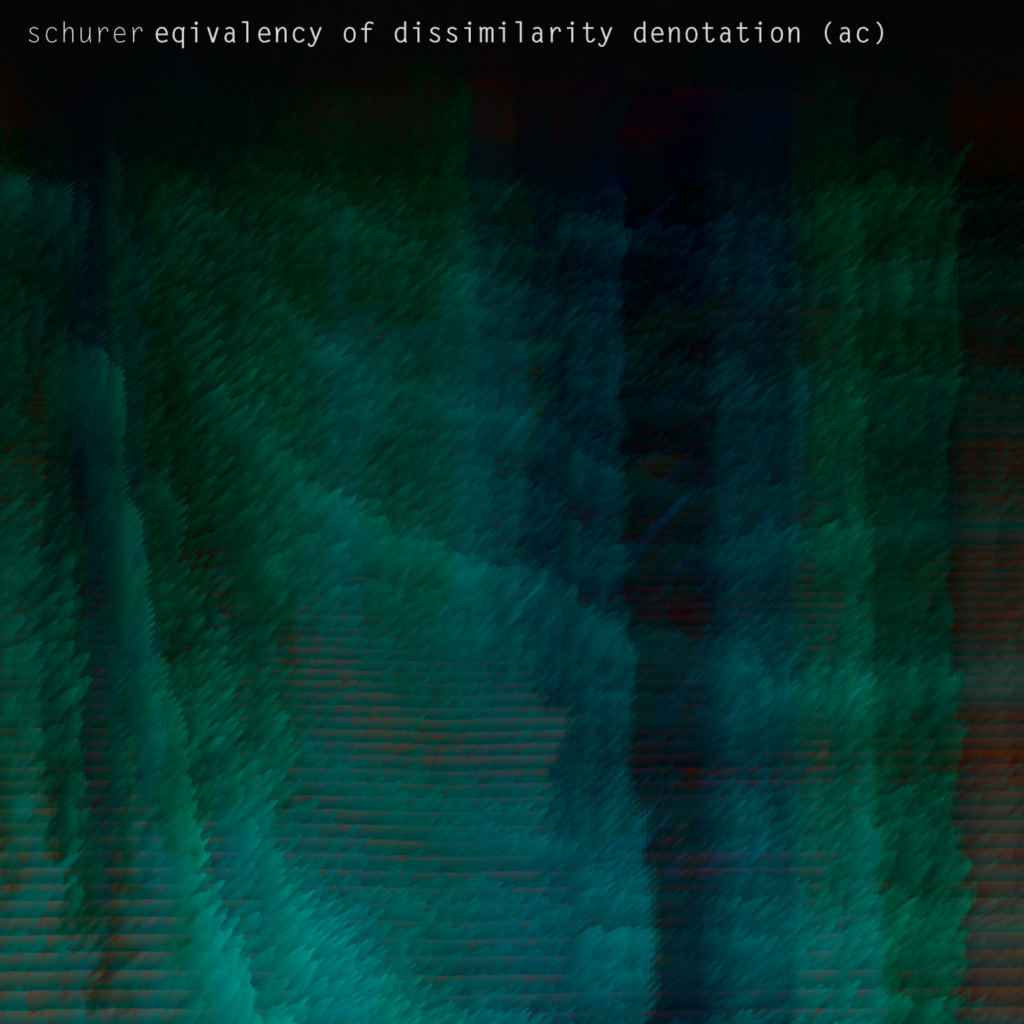
equivalency of dissimilarity denotation (analog shift registers) 2026
EoDD/XVM, a collective of conceptual art works initiated by Bernd Schurer, emerged as a revolutionary force in the nascent days of the internet art world in the late 1990s. Their creations transcended traditional mediums, utilizing hypertext, the internet, and analog and digital sound computers. Unlike conventional art, XVM prioritized ideas, perception, and critical reflection over physical objects, spectacle, and performance. By challenging established art concepts and rejecting non-systematic approaches to philosophical debate, system theory, and cybernetics, they fundamentally redefined notions of authorship, (re-)presentation, and art-making. The group’s work centered around probing the systems that imbue art with meaning. Through their antiorp.net channel, XVM engaged in “Art as Philosophy,” presenting powerful sound pieces, obfuscated HTML code, and introspective musings and ramifications as schizo-personas.
Bernd Schurer (born, Zurich, 1970) is a sound artist, researcher, and composer of electronic music living in Berlin for the last 18 years.
Schurer is one the absolute pioneers of extreme computer music amongst other mischievous and radical online activities in the nascent days of the internet.
In a long running and somewhat confrontational practice Schurer has explored physical and psychological experiences through computational formalization processes.
Soliloquy Synthesis was created in anticipation of his father’s passing.
The composition was presented in front of an intimate audience at the NNOI festival in Zernikow, Brandenburg, Germany, July 2025. A week after the anticipated event transpired.
Under twinkling stars and flickering fires, what was it good for? A game.
Gratitude to all you beautiful beings: Maria, Josef, Sonja, Alberto, Marcus, Renate, Eliane, Jason B, Simon B., Simon G., Miriam, Bettina, Michael, Robert, Randy, Chris J, Sabine, Mark, Stephan W and Marina.
credits
released March 26, 2026
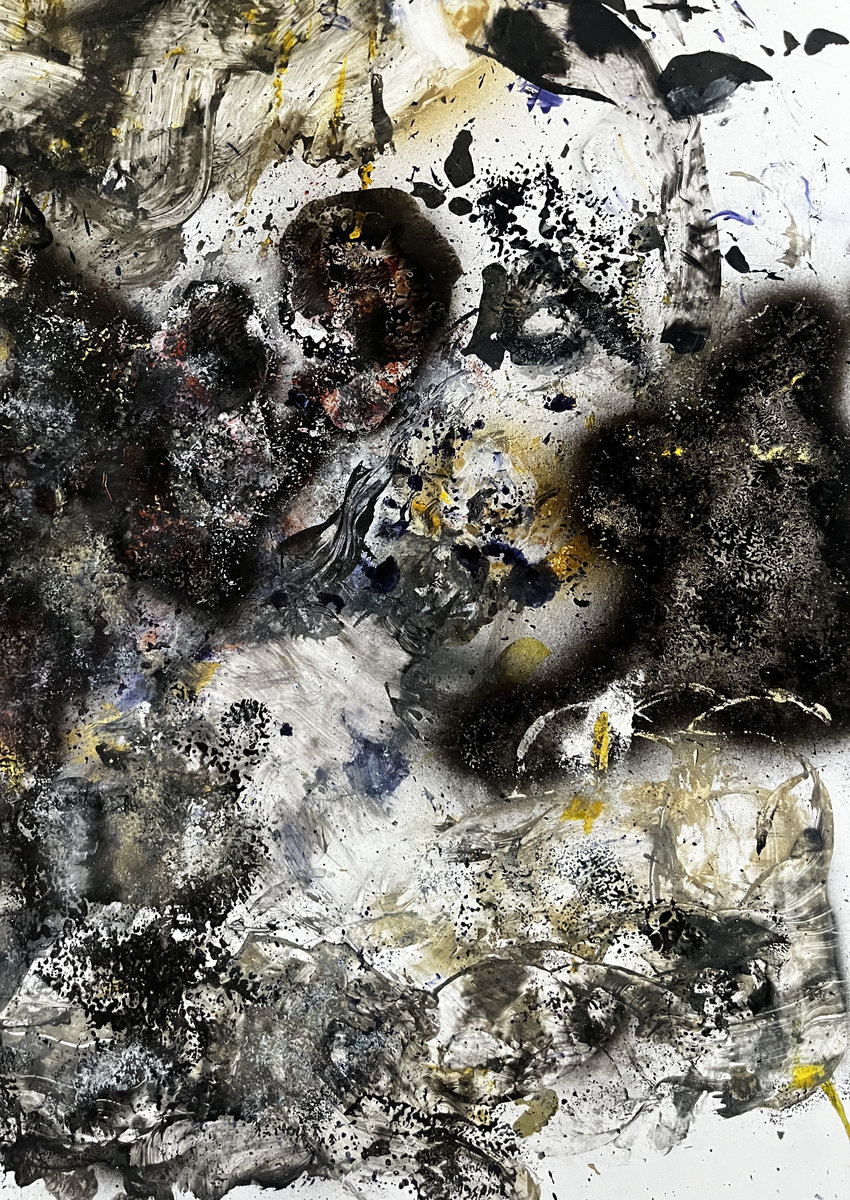
Music by Bernd Schurer. Mastered by Rashad Becker. Cover Painting by Mark Harwood.
Some experimental philosophical thoughts on “The Narrow.” started out as a conversation with ChatGPT about the Tritone Paradox in my computer music composition, Lacanian Sieve.
_
1. Narrowness as a Constraint on the Symbolic
When a piece commits to one interval as its total structural horizon, the listener is placed in a space where symbolic differentiation is strictly limited. The Symbolic (in Lacanian terms) becomes a single axis—a filtration of all musical possibility through one cut, one relation, one “law.”
Psychologically, this produces:
A sense of cognitive claustrophobia: the mind searches for alternative relations, but the system refuses them.
A heightened awareness of micro-differences: the listener is forced into an obsessive, nearly analytic parsing of tiny variations.
A feeling of being “locked in”: as if the system only permits motion along a very tight corridor.
This can be described as epistemic narrowness: the world is small, but infinitely deep.
2. Tightness as Affective Constriction
The tritone carries centuries of ambiguity and tension, but without relying on tonal baggage you can emphasize its structural role: it is an interval that never fully relaxes. When it becomes the only possible gesture, a paradox emerges: the tension is constant, yet endlessly mutating.
This shapes the emotional field in the following ways:
Persistent non-resolution → a condition of suspended desire.
Pressure without release → an affective “tightness,” often experienced somatically (sternum, throat, solar plexus).
A narrowing of emotional bandwidth which paradoxically amplifies sensitivity—when all gestures compress around a single relation, small differences become emotionally charged.
You could describe this as affective torsion: the piece bends the listener inward rather than outward.
3. Narrowness as a Model of Psychic Repetition
A system rooted in a single interval, especially a dissonant and “unplaceable” one like the tritone, can be heard as a form of compulsion to repeat. Not repetition of identity, but repetition of difference within sameness—a hallmark of the unconscious.
This resonates with:
Obsessive thinking → circling around a single structuring absence.
Traumatic repetition → the return of something that cannot be metabolized.
The Real pressing through a closed Symbolic loop.
You can say: The music stages the psyche encountering an impossible limit, again and again, as if attempting to master it—but never doing so.
4. Narrowness as Spatial Metaphor: The Corridor, the Throat, the Aperture
Computer music often generates topologies rather than narratives. If the tritone is the only generative relation, the topology becomes narrow:
Like a long corridor that changes thickness, humidity, temperature, but never opens into a room.
A throat that constricts or dilates but never speaks.
A fissure or crack: the listener inhabits the inside of a fault line, not the outside.
Emotionally, this evokes:
Unheimlich tightness (the familiar inflected with the strange).
Anxiety without panic: the walls are close, but stable.
A beauty produced by proximity: microstructures become intimate, almost erotic.
You might call this spatialized affect: the emotional state is coextensive with the geometry of the interval.
5. Narrowness as Sonic Ethics: The Refusal of Abundance
By restricting the entire musical universe to tritone variations, the piece refuses abundance in favor of rigor, discipline, and radical minimality.
Psychologically, this can be interpreted as:
An ethics of renunciation: nothing is allowed except what the system permits.
A confrontation with lack rather than its concealment.
A purification of attention: the listener becomes aware not of what is present, but of what is missing.
This narrowness becomes ascetic, almost monastic—but with an underlying violence.
6. The Emotional Implication of Infinite Variation within Tight Bounds
Here the key is the infinite in tension with the narrow.
Because the tritone is the only interval, but it appears in limitless permutation:
The listener confronts infinity-in-a-sliver.
There is a vertigo of smallness: infinite depth but no lateral expansion.
This often produces a strange calm—resignation mixed with fascination.
Psychically, this mirrors:
The way obsession makes one detail inexhaustible.
The way desire attaches to a single object-cause (objet a) whose variations are limitless.
The way trauma lodges a world inside a single point.
Blind Material Volume II is the companion album to Lacanian Sieve (domizil 52) by Bernd Schurer. The composition Vortexification, an unfinished “work of crisis”, is released on cassette tape solely to exist. The digital download includes additional sound materials generated similarly (Sieves in SC, see Xenakis, Roads et al) as those found on Lacanian Sieve.
What is it good for? A Game.
credits
released June 22, 2025
published by domizil 2025. all music by bernd schurer.
“If this music can be narrated, it resonates in the narrative. At least it has changed me physically, this narrated music. It modulates my waves, my relationship to the wind, to the medium of music. And if that is not proof for you, please. Then why should I help you any further? After all, I have other things to do. The wind has infected me. I have to devote myself to it.”
credits
released February 23, 2025
All music by Bernd Schurer. Published by domizil 2025. Text: Tim Zulauf
A celebration of the Swiss computer music label domizil & friends – with electronic music concerts, diffusions and a new CD edition.
Line Up:
live:
Asmus Tietchens (DE)
Thomas Ankersmit (NL/DE)
Alberto de Campo (AT/DE)
Bernd Schurer (CH/DE)
Daisuke Ishida (JP/DE)
Benjamin Flesser (DE)
Martin Neukom (CH)
Ralph Steinbrüchel (CH)
Darien Brito (EC/NL) – electroacoustic diffusion of the “Debris”-cycle
Installation: Devotionalie, Marcus Maeder, 1996/2016
–
Date: Sat, 10.12.2016
Venue: silent green Kulturquartier, Cupola
Gerichtstraße 35
13347 Berlin www.silent-green.net
Doors: 16:30
Start: 17:15 *
Tickets (at the door): 15.-€
*we start early, so please come on time. Last concert will be 22:30.
About: domizil commenced in 1996 on the initiative of artists Marcus Maeder and Bernd Schurer in Zürich, Switzerland. domizil sees itself as a platform for coordination, presentation, production, interchange and cooperation, focusing on publishing and distributing the work of its network of artists – via record releases, events, installations and electronic music concerts. From its first release, domizil has been poised for an in-depth exploration of digital culture, its sounds,
methods and social context. The aesthetic focus lies on sonic art and all the many facets of this practice today – well beyond genre and definition. www.domizil.ch
The Zürich event at Kunstraum Walcheturm will be announced shortly.
–
Artist Bios: (sorry for the mismatch of english and german, will be corrected shortly)
Asmus Tietchens (DE)
Synthesizer experimentalist and musique concrète producer Asmus Tietchens began recording in the mid-‘60s and continued to record three decades after that. Born in 1947 and based in Hamburg, Tietchens listened to German radio as a child and heard pioneering electric transmissions by the likes of Stockhausen and Gottfried Michael Koenig. He began recording his own home experiments in 1965 with crude reverb devices and picked up a MiniMoog several years later. Also influenced by atonal Kraut-rockers like Cluster and Faust, Tietchens met Okko Bekker and began a partnership that lasted for decades (Bekker has produced most of Tietchens‘ work). After Tangerine Dream‘s Peter Baumann heard a tape of his work, he produced Tietchens‘ debut album Nachtstücke, released in 1980 on Sky Records. His four albums for Sky during the early 80s focused on surprisingly accessible electronic pop, though 1984‘s Formen Letzter Hausmusik (recorded for Nurse with Wound‘s United Dairies label) began a period of more abstract, concrète recordings that often use tape experiments as well as synthesizers. During the 90s, Tietchens recorded for experimental labels Barooni, Staalplaat and Syrenia, the latter a 1996 collaboration with Vidna Obmana. Since 1990, he has also taught sound at a Hamburg university. http://www.tietchens.de/
Alberto de Campo (AT/DE)
Alberto de Campo, Künstler, Musiker, Komponist, arbeitet in sehr verschiedenen Kontexten. Er hat Komposition und Jazz-Gitarre in Österreich studiert, und elektronische Musik / Computermusik in den USA. Er war Visiting Scholar und Research Director am CREATE (an der UC Santa Barbara); danach hat er am IEM Graz und an der Kunsthochschule für Medien Köln (KHM) gelehrt. 2004/5 hatte er die Edgard Varèse-Gastprofessur für Elektronische Musik an der TU Berlin inne.
Von 2005-2007 war er lead researcher im Forschungsprojekt ‘SonEnvir’ (am IEM Graz), das mit einem interdisziplinären Team die Anwendbarkeit der Sonifikation von Daten für verschiedene wissenschaftliche Disziplinen experimentell untersuchte. Von 2007-2009 war er Professor für Musikinformatik am Institut Fuer Musik Und Medien der Robert Schumann Hochschule Düsseldorf, und seit 2009 ist er Professor an der Universität der Künste Berlin.
Er arbeitet mit den Ensembles powerbooks_unplugged, Quiet Noise Quartet, realtime_research, mit Elisabeth Harnik, Florian Hecker, Marcus Schmickler, und vielen anderen. Seine Interessen umfassen algorithmische Kunst, just-in-time programming, Improvisationspraxen, Sonifikation wissenschaftlicher Daten, und selbststeuernde Systeme.
Der Zürcher Musiker und Grafiker Ralph Steinbrüchel (*1969) arbeitet seit vielen Jahren, sowohl musikalisch als auch visuell an der Erschaffung von Texturen und Atmosphären durch stringente Reduktion. Das Aufeinaderschichten minimaler Variationen, deren Schichtungen immer wieder neue Strukturen und Formen ergeben, steht im Zentrum seines Schaffens. Sowohl in der Musik als auch in der visuellen Gestaltung arbeitet Steinbrüchel mit Gestaltungsrastern, minimaler Varianz und bewusstem «Weissraum» (Grafik) bzw. Stille (Musik.) Damit steht sein Werk, geprägt von Reduktion, in bester Tradition der Schweizer Grafik.
Mit zahlreichen Veröffentlichungen und Konzerten hat Steinbrüchel sich im Bereich der elektronischen Musik bereits international einen Namen gemacht. 2002 wurde sein Werk in New York vom Österreichischen Kulturamt mit dem Max Brand Preis für elektronische Musik ausgezeichnet. Er erhielt bisher zwei Kompositionsaufträge der Schweizerischen Kulturstiftung Pro Helvetia. Steinbrüchel veröffentlicht seit 20 Jahren elektronische Musik auf diversen Labels wie zum Beispiel Domizil (CH), 12k (USA), LINE (USA), Room40 (AUS), NVO (A). Zudem wurden einige Kollaborationen mit Bernd Schurer, Frank Bretschneider, Cory Allen und Machinefabriek erarbeitet und veröffentlicht. http://www.synchron.ch/
Thomas Ankersmit (NL/DE)
(*1979, Leiden, Netherlands) is a sound and installation artist based in Berlin and Amsterdam. Acoustic phenomena such as sound reflections, infrasonic vibration, otoacoustic emissions, and highly directional projections of sound have been an important part of his work since the early 2000’s. His work is also characterized by a deliberate misuse of the equipment, using feedback and disruptions to the signal, and the extremes of frequency and dynamics, to create visceral but finely detailed swarms of sound. Since 2006 his main instrument, both live and in the studio, has been the Serge analogue modular synthesizer. http://thomasankersmit.net/
Daisuke Ishida (JP/DE)
Daisuke Ishida ist ein in Berlin basierter Künstler, der mit Klang und zeitgenössischen Medien arbeitet. Er interessiert sich für die Konsequenzen der künstlerischen Praxis und Theorie in Klang, Raum und Wahrnehmung. Seine multidisziplinären Untersuchungen umschließen Bereiche wie Akustik, Architektur, auditive Wahrnehmung, Computer-Musik und andere verwandte Fachgebiete. Seit dem Jahr 2012 lehrt er an der Universität der Künste Berlin beim UNI.K Studio für Klangkunst und Klangforschung und im Masterstudiengang Sound Studies. 2009 gründete er AUSREIHE, eine unabhängige Organisation, die sich auf experimentelle Elektronische / Computer-Musik spezialisiert hat. Zusammen mit Ken Furudate, Kazuhiro Jo und Mizuki Noguchi rief er 2002 The SINE WAVE ORCHESTRA ins Leben, dass im Jahr 2004 eine Honorary Mention in der Kategorie Digitale Musik des Prix Ars Electronica 2004 gewürdigt wurde und 2009 ein Stipendium der Stiftung Niedersachsen für Medienkunst am Edith-Ruß-Haus erhielt. Daisuke Ishida präsentierte seine künstlerischen Arbeiten bereits bei mehreren internationalen Institutionen und Museen, unter anderen bei Ars Electronica (Östereich), Arsenals of the Latvian National Museum of Art (Lettand), deaf – Dutch Electronic Art Festival (Niederlande), Edith-Ruß-Haus für Medienkunst (Deutschland), ICC – InterCommunication Center (Japan), Interferenze New Arts Festival (Italien), International Triennale of Contemporary Art Yokohama (Japan), ISEA – Inter-Society for the Electronic Arts (USA), MART – Museum of Art, Rovereto and Trento (Italien), MOT – Museum of Contemporary Art Tokyo (Japan), Singuhr Hoergalerie (Deutschland), SMT – Sendai Mediatheque (Japan), Steim (Niederlande), sowie Transmediale (Deutschland) und YCAM – Yamaguchi Center for Arts and Media (Japan). http://isddsk.com/
Martin Neukom (CH)
Studien 21
Konzert für dreidimensionale Klangprojektion (Ambisonics)
Martin Neukom studierte Musikwissenschaft, Mathematik und Psychologie an der Universität Zürich und Musiktheorie an der Musikhochschule Zürich. Er ist Dozent für Musiktheorie, Mathematik und Musikinformatik am Departement Musik und wissenschaftlicher Mitarbeiter am Institute for Computer Music and Sound Technology ICST der Zürcher Hochschule der Künste. http://www.domizil.ch/neukom.html
Bernd Schurer (CH/DE)
Bernd Schurer, geboren 1970 in Zürich, ist Klangkünstler und Komponist Elektronischer / Elektroakustischer Musik. In der Schweiz studierte er Philosophie und Filmwissenschaften, Bildende Kunst und Komposition. Heute lebt und arbeitet er in Berlin. Der Kern seiner Werke umfasst die Thematisierung von Wahrnehmungsaspekten des Hörens mit erweiterten Methoden zur Komposition von wahrnehmungsspezifischen Eigenheiten im Klang und deren Spatialisierung. Mittels Techniken digitaler Klangsynthese, der Psychoakustik und der Erkundung der Zahl als gemeinsamem Objekt von Musik und Mathematik entwickelt Schurer dramatische “Sound Pieces”. Seine Arbeiten bestehen aus zahlreichen Kompositionen Elektronischer Musik, Audiopublikationen, Werkaufträge für Ensembles, internationale Konzert- und Ausstellungstätigkeit, Installationen und kuratorische Tätigkeit, sowie preisgekrönte Kompositionen und Klanggestaltungen für Filme. Durch Interventionen und
Zusammenarbeiten mit dem Schweizer Medienkünstler Yves Netzhammer wurde Schurer auch bekannt im Bereich der Bildenden Kunst – diese Kollaborationen führten u.a. zu Präsentationen an der Biennale von Venedig 2007 oder der documenta 12 in Kassel (Karlskirche). Er ist Gründungsmitglied des Schweizer Klangkunst-Labels domizil. http://heterophenomenological.net/ http://hyperlinear.net/
Benjamin Flesser (DE)
Benjamin Flesser is a media artist and composer. He works with modular synthesizers and manipulated or self built electronics. In one of his earlier performances „Verlust von Aufnahmefähigkeit“, he used a amplified diamond saw to cut a running microphone in half. He lives and works in Berlin. https://benjaminflesser.bandcamp.com/ http://hyperlinear.net/
Darien Brito is a composer/performer from Ecuador currently based in The Hauge, The Netherlands, working with audiovisual elements through technology. The main concerns in his work are segmented musical forms, micro-sound, generative algorithmic structures and sound design by itself. The visuals aspects in his pieces are an extension or counterpart to this concerns. He holds an MA in Sonology, Institute of Sonology-Royal Conservatory of The Hague and works as a Research Associate, Institute of Sonology-Royal Conservatory of The Hague, The Netherlands. http://darienbrito.com/
–
Installation:
Devotionalie
Marcus Maeder, 1996/2016
Sockel, Kassettengerät, Kassette
Devotionalien sind Gegenstände, die der Andacht (lateinisch devotio ‚Hingabe‘, ‚Ehrfurcht‘) und der Förderung der Frömmigkeit dienen sollen. Maeders Installation „Devotionalie“ ist eine Neuinterpretation der urprünglichen Version von 1996, die anlässlich der Ausstellung „Kiss the future“ im Kunstmuseum Luzern ausgestellt wurde. Auf einem goldenen Sockel steht ein Kassettengerät aus den 1970er-Jahren. In dieses eingelegt ist eine Kassette mit elektronischer Musik, die sich mit einem danebenliegenden Kopfhörer hören lässt. Neben dem Gerät liegt weiter die Kassettenhülle, mit einem Bild aus der Agglomeration Zürichs auf seiner Frontseite. Auf der Kassette steht nichts weiter als „domicile edition.“ Während die ursprüngliche Version aus einer auf den Boden aufgemalten runden Fläche bestand, hebt der Sockel nun symbolisch die restlichen Installationkomponenten um 20 Einheiten.
Bernd Schurer’s speziell für den Event entworfenes “Soliloquy Synthesis – Cybernetic Noise Wash” ist eine elektroakustische Live-Aufführung innerhalb der bühnenartigen Installation “Selbstgespräche nähern sich wie scheue Rehe” von Yves Netzhammer im Lichthof des LWL – Museums für Kunst und Kultur. Digital generierte Sound-Entitäten verwickeln sich in sich selbst koordinierende Klang-Monologe vor dem Hintergrund streng kybernetisch und algorithmisch erzeugter Flächen und Weissräumen. Sie erweitern dadurch die von Schurer für die Installation geschaffene Tonspur um ein dramatisches, räumliches Soundpiece.
–––
Der in der Schweiz aufgewachsene und in Berlin lebende Klangkünstler und Komponist Elektronischer Musik Bernd Schurer (* 1970) thematisiert in seinen Arbeiten Perzeptionsaspekte des Hörens. Mittels Techniken digitaler Klangsynthese, der Psychoakustik und der Erkundung der Zahl als gemeinsames Objekt von Musik und Mathematik sonifiziert er ein vielschichtiges Feld für Auseinandersetzungen spezifischer Erfahrungen von Raum, Psyche, Körper und Zeit.
Sound artists and composers have always worked with the effect of sound. But what is the difference when one actively and consciously applies psychoacoustic knowledge to composition? These 33 sound-pieces try to artistically explore the brain’s and the ear’s relation between objectivation and subjective perception using a series of digitally created tone patterns to stimulate otoacoustic emissions within the listener’s ear. An otoacoustic emission (OAE) is a sound which is generated from within the inner ear. In the sound-piece I am concentrating on evoking auditory perceptual and physical stimuli – when at least two tones with close fundamental frequencies are sounded together, another tone whose frequency is the sum or difference of the original two tones is heard. This ghost tone is purely made up by the human ear and brain. To compose with “absent sound” is the main inspiration to add to this relatively seldom experienced phenomenon (although a lot of “experimental composers” have integrated “ear-tones” in their artistic practice – Maryanne Amacher, Jacob Kirkegaard, Marcus Schmickler, Thomas Ankersmit et al).
In the 33 scripted sound-pieces in the installation version I will focus on three unique characteristics of ear-tones, composing soundforms that take place and agitate between the inside and the outside of the listener’s heads an using a non-symmetrical 3 channel speaker layout for diffusion and inclusion of the physical space in the gallery.
Artists: Bernd Schurer, Salome Voegelin, Raul Keller, Manuel Rocha Iturbide, Ish S (diFfuSed beats), Hemant Sreekumar, Colin Black, Shun Owada and others.
Schurer’s composition “residue” is part of Yves Netzhammer‘s contribution to the 2nd Kyiv Biennial 2015, Ukraine, “The School of Kyiv”, curated by Hedwig Saxenhuber and Georg Schöllhammer, as a spatial soundtrack.
Contingency Test ist ein ästhetisches Experiment zu Thesen der Klangphänomenologie.
Eine Auswahl von Klangstudien zu bestimmten Bereichen der selektiven Wahrnehmung unter Einbeziehung psychoakustischer Effekte, in eine offene Form der Möglichkeit transformiert.
Der Eindruck dessen, was wir hören, kann durch die Darstellung von mechanischen Vibrationen nicht zufriedenstellend beschrieben werden. Es wäre eine Beschreibungsform nötig, die die Selektivität und die Nichtlinearität des Gehörs und die Integration und Interpretation des Wahrgenommenen berücksichtigt. Albert Bregman’s “Auditory Scene Analysis” unterscheidet zwischen einem Wahrnehmungsstrom und einem Einzelereignis. In den Studien zu Contingency Test wird eine Palette von experimentellen Daten verwendet, um diese Segregation in einzelne Bestandteile und Reihen künstlerisch zu erkunden. Zu einer Betrachtung des Problems der Kontinuität werden hierfür Klangpartikel nach den wichtigsten Faktoren Zeitablauf, Frequenz und Klangfarben aufgetrennt und in einer Auditiven Szene ausgearbeitet. Das Produkt ist imaginär und synthetisch, wir hören über unsere Ohren hinaus, die Ereignisse und Klangobjekte sind nicht offenkundig, die Neigung zur Vervollständigung und Kohärenz wird unterlaufen.
Der Zürcher Computermusiker und Künstler Bernd Schurer (* 1970) untersucht in seinen Arbeiten die Beziehungen von Raum, Zeit, Körper und Klang in ihren unterschiedlichen Wahrnehmungskontexten. Schurer studierte Philosophie und Komposition in Zürich, sowie Bildende Kunst in Luzern. Seit 1996 kuratiert er zusammen mit Marcus Maeder die Klangeditionen auf domizil.ch. Er lebt in Zürich und Berlin.
Mit freundlicher Unterstützung des Institut für Computermusik und Soundtechnologie (ICST), Kunstraum Walcheturm und der Zürcher Hochschule der Künste (ZHdK).